


By Chisom Juanita Mefor
Cancer research depends not only on scientific innovation, but also on infrastructure. While laboratories, sequencing platforms, and clinical expertise often receive the most attention, an equally important foundation lies in the quality and structure of the clinical data that supports research. Without reliable clinical information linked to patient outcomes, even the most advanced biomedical technologies cannot produce meaningful insight.
Across much of Africa, the challenge is not simply the absence of data, but the fragmentation of it. Hospitals, laboratories, and registries frequently operate with different documentation systems, inconsistent coding practices, and incompatible digital platforms.
In many countries, cancer information is still captured primarily through paper-based records and hospital-specific registries. Population-based cancer registries, which are essential for understanding incidence and outcomes at scale are limited. According to the African Cancer Registry Network (AFCRN), only a small proportion of African nations maintain high-quality population-based registries, and most registries cover only selected regions or facilities rather than entire populations.
For example:
- In Nigeria, several hospital-based cancer registries (Ibadan, Abuja, Calabar) exist, but the absence of a fully linked national system means data is often incomplete and difficult to compare across institutions.
- In South Africa, the National Cancer Registry collects pathology-based cancer data annually, but its population coverage and longitudinal follow-up outside major urban centers remain limited.
- In Kenya, population-based registries in Nairobi and Eldoret provide valuable insights, but they cover only a fraction of the country, and many counties still lack routine cancer surveillance.
As a result, patient records that could otherwise reveal patterns in disease progression, treatment response, or population-level risk factors remain difficult to combine, analyze, or interpret at scale.
This fragmentation has profound implications for cancer research. Hematologic malignancies such as leukemia, lymphoma, and multiple myeloma require longitudinal observation, precise clinical classification, and careful documentation of treatment outcomes. When clinical information is incomplete or inconsistent, the ability to conduct rigorous translational research is severely limited. Biospecimens may exist, and clinicians may observe meaningful patterns in care, but the absence of standardized clinical data prevents these observations from becoming reproducible scientific evidence.
Standardization addresses this gap. Structured clinical datasets, built using consistent definitions, shared coding frameworks, and interoperable formats allow researchers to aggregate information across hospitals and regions. When clinical data is standardized, patient records become part of a larger, analyzable dataset rather than isolated case histories. This enables researchers to track disease trajectories, compare treatment outcomes, and identify patterns that would otherwise remain invisible.
For cancer research in Africa, the stakes are particularly high. According to the International Agency for Research on Cancer (IARC) GLOBOCAN 2020 estimates, there were over 900,000 new cancer cases and more than 580,000 cancer deaths in Africa in 2020, with many cancers diagnosed at advanced stages. These figures likely underestimate the true burden because of incomplete data capture and follow-up.
African populations also remain underrepresented in global genomic and clinical research datasets, especially in hematologic cancers. This underrepresentation limits the global understanding of disease biology, treatment response, and genetic variation across populations. Building robust datasets that accurately reflect African patient populations is therefore not only a regional priority but a global scientific necessity.
The development of standardized clinical data systems also strengthens local research capacity. When hospitals capture structured, interoperable clinical data, they create an environment where clinicians and researchers can generate evidence directly from the populations they serve. Over time, this evidence supports better clinical guidelines, more informed public health policy, and research collaborations that are grounded in locally generated data rather than imported assumptions.
Achieving this level of data quality requires more than digitizing hospital records. Digital systems alone do not guarantee research-ready data. Effective data infrastructure depends on thoughtful design: standardized clinical variables, clear documentation protocols, trained personnel, and governance frameworks that ensure ethical data stewardship. Interoperability standards must allow data to move across systems, while quality controls ensure that information remains reliable and comparable across institutions.
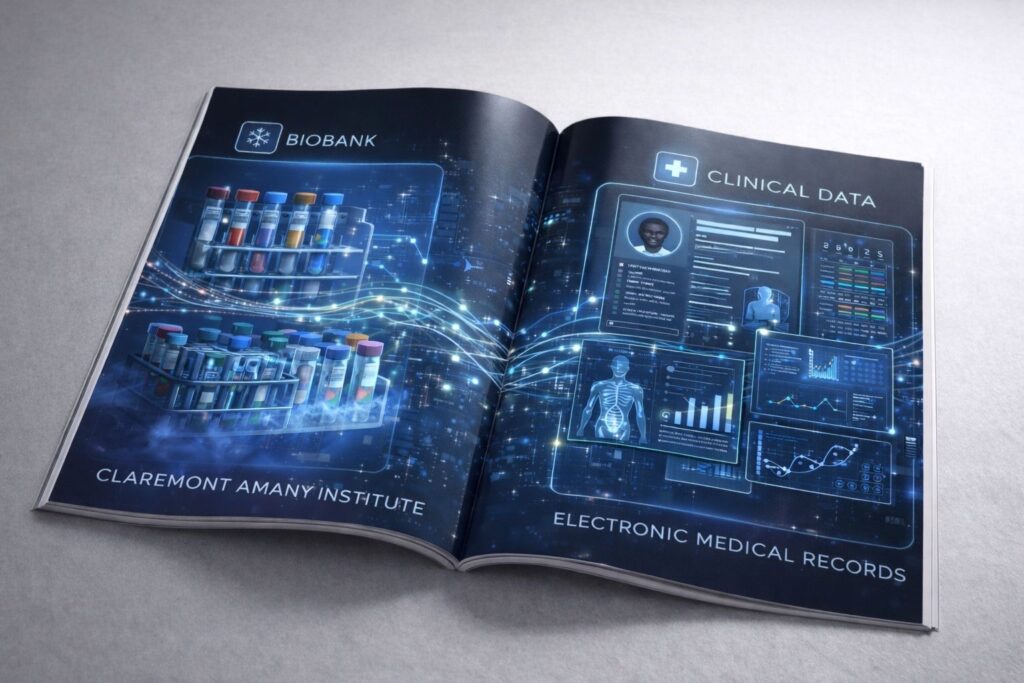
This is where institutions focused on research infrastructure play a critical role. The Claremont Amany Institute (CAI) was established with the recognition that cancer research in Africa requires durable, ethically governed infrastructure that integrates biospecimens, clinical data, and genomic analysis. CAI’s flagship initiative, the African Hematologic Cancer Biobank, addresses the longstanding underrepresentation of African populations in hematologic cancer research by building a repository of high-quality biospecimens linked to structured clinical and genomic data.
By pairing biospecimen collection with standardized clinical datasets, the Institute enables researchers to move beyond isolated observations toward population-level analysis. Longitudinal patient data allows scientists to study disease progression, evaluate treatment outcomes, and investigate genetic drivers of cancer within African populations. These datasets, managed under strict ethical and governance frameworks, also create opportunities for collaboration with academic institutions, public health agencies, and industry partners committed to advancing equitable biomedical research.
Importantly, the value of such infrastructure extends beyond research alone. When clinical data systems are standardized and interoperable, they also support improvements in care delivery. Clinicians gain clearer insight into treatment outcomes, policymakers obtain stronger evidence for health system planning, and researchers can design studies that reflect the real-world experiences of patients across the continent.
Standardized clinical data therefore represents more than a technical improvement. It is the connective tissue that links patient care, biomedical discovery, and public health insight. Without it, biospecimens remain underutilized, clinical observations remain anecdotal, and research remains fragmented. With it, the same information becomes a powerful resource capable of driving discovery and improving care.
As African research institutions, hospitals, and policymakers continue to expand digital health infrastructure, the next step is ensuring that these systems produce structured, interoperable, and research-ready data. Doing so will transform everyday clinical encounters into a foundation for scientific knowledge.
In this sense, standardized clinical data is not merely a supporting tool for cancer research, it is one of its most important forms of infrastructure. By investing in systems that capture, structure, and connect clinical information responsibly, Africa can generate the evidence needed to advance cancer care, strengthen research capacity, and contribute meaningfully to the global understanding of disease.